Back to Blog Blog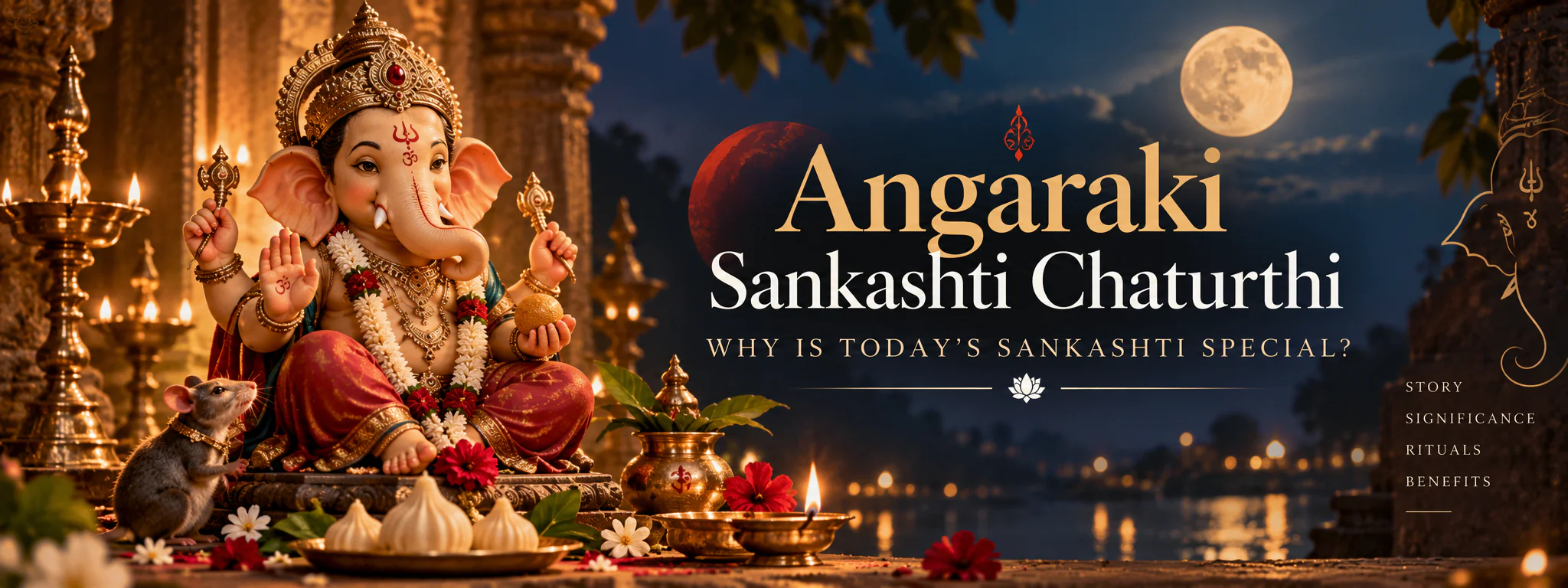
Angaraki Sankashti Chaturthi: Why Is Today’s Sankashti Special?
Today, September 29, 2026, is Angaraki Sankashti Chaturthi, a special Sankashti observance because it falls on a Tuesday.
29 September 2026 3 min read
Sankashti Chaturthi comes once every lunar month and is dedicated to Lord Ganesha. But when Sankashti falls on a Tuesday, it is known as Angaraki Sankashti Chaturthi—a particularly significant day for Ganesha devotees.
And today, September 29, 2026, is Angaraki Sankashti Chaturthi, also known as Vighnaraja Sankashti Chaturthi.
But why is a Tuesday Sankashti called Angaraki?
The Story of Angaraka
According to a traditional account associated with the Ganesha Purana, Angaraka was the son of Sage Bharadwaja and Mother Earth. He was a devoted worshipper of Lord Ganesha and performed intense penance to seek his blessings.
Pleased with his devotion, Ganesha appeared before him and offered him a boon.
Angaraka did not ask for wealth, power or worldly possessions.
He asked for something very different:
He wanted his name to remain forever connected with Lord Ganesha.
Ganesha granted his wish.
He declared that whenever Sankashti Chaturthi fell on a Tuesday, it would be known as Angaraki Chaturthi. Traditional accounts say that observing the vrat and worshipping Ganesha on this day carries special spiritual merit.
And that is how this particular Sankashti got its name.
What Does “Sankashti” Mean?
The word Sankashti is associated with overcoming difficult circumstances or troubles.
Sankashti Chaturthi falls on the fourth day of Krishna Paksha, the waning phase of the Moon. Devotees traditionally observe a fast during the day and perform Ganesha puja in the evening.
The vrat is generally completed after moonrise, following the customary prayers and offering of arghya to the Moon.
This is what makes Sankashti different from the better-known Ganesh Chaturthi celebrated during Shukla Paksha.
Why Is Tuesday Important?
Tuesday is traditionally associated with Mangal (Mars), which is also known as Angaraka.
So when Sankashti Chaturthi—the day dedicated to Ganesha—falls on Tuesday, the two associations come together.
Ganesha is traditionally worshipped as Vighnaharta, the remover of obstacles, while Mangal is associated in Hindu astrology with qualities such as energy, courage and action.
This combination is why Angaraki Sankashti is considered especially significant in traditional practice.
What Do Devotees Do Today?
Traditions vary between families, but a typical Angaraki Sankashti observance includes:
Fasting during the day
Worshipping Lord Ganesha
Offering durva grass, flowers and modak or other naivedya
Chanting Ganesha mantras or reciting Ganesha stotras
Waiting for moonrise
Offering arghya and completing the vrat
A simple mantra often chanted during Ganesha worship is:
ॐ गं गणपतये नमः
Om Gam Ganapataye Namah.
For the exact moonrise and fasting time, devotees should follow the local Panchang, because moonrise differs from city to city. For Bengaluru, one current astronomical calculation places moonrise at approximately 8:08 PM tonight.
What Makes Angaraki Special?
There is something beautiful about the story of Angaraka.
He had the opportunity to ask Ganesha for anything.
Instead of asking for material wealth, he asked for a lasting connection with the deity.
His wish became part of the calendar itself.
Every time a Sankashti falls on a Tuesday, his name is remembered.
That is the story behind Angaraki Sankashti Chaturthi.
Today, devotees observe the vrat not simply as another fasting day, but as an opportunity to turn towards Ganesha, seek clarity and pray for obstacles to be overcome.
And when the Moon finally rises, the day's fast comes to an end—with Ganesha's name, a prayer and gratitude.
May Lord Ganesha remove the obstacles from your path and bless you with wisdom, strength and clarity.